The Lesbian Film Archive
Thoughts on the 1990s
In the opening sequence of Go Fish, Kia, a professor, urges her students to name lesbians they can think of. A list that grows to includes Lily Tomlin, Audre Lorde, the entire cast of Roseanne, and Eve (of the Bible). When one students asks why they are speculating, Kia remarks, “throughout lesbian history, there has been a serious lack of evidence that will tell us what these women’s lives were truly about. Lesbian lives and lesbians relationships barely exist on paper, and it is with that in mind, and understanding the meaning and power of history that we begin to want to change history”. This lecture acts as a thesis for many of these 90s lesbian films: in creating a filmic trail for lesbians and lesbian relationships, even a fictional one, there is the ability to both understand and create history.
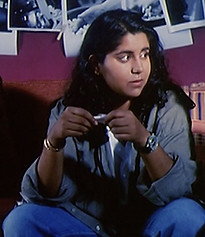
With 19 films, this section is unsurprisingly in the smallest on the archive, as queer cinema was still an emerging genre. However, unlike many of the films from the other time periods, the vast majority of these films are made by lesbians. While lesbians continue to make lesbian films throughout the decades, it feels important that the 90s films are so characterized as being specifically directed (and often times written) by lesbians as well. Thus the films feel intentionally personal; self reflexive, low budget, and oftentimes directorial debuts. Two standout examples of this are Watermelon Woman and Chutney Popcorn, which are written and directed by Cheryl Dunye and Nisha Ganatra respectively, and star the writer/directors in films themselves. This self-representation allows the films to reflect the experience of Black lesbians and Indian-American lesbians. Even outside of these two films, the films of the 90s stand out through the ways in which these films attempt to justify, within their text, as to why these films are being, as well as speak to each other across the boundaries of film as a singular installment.
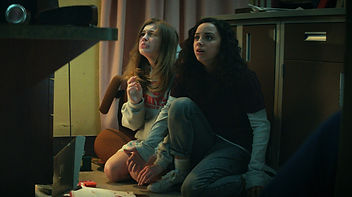
Another key element to these films is the intertextuality between them. As each of these films carved a bigger space for lesbian films, they also remain indebted to each other and other crucial lesbian ephemera. These referents are littered throughout the films: Cheryl in The Watermelon Woman mentioning Go Fish (both of which star Guievere Turner), Evie's friends reading Rubyfruit Jungle in The Incredibly True Adventure of Two Girls in Love to process their friend’s newly revealed sexuality, Alex in It's in the Water renting movies to help her better understand her new queer feelings, a list that includes Heavenly Creatures, Bar Girls, Claire of the Moon, and The Incredibly True Adventure of Two Girls in Love, Megan’s Melissa Etheridge poster in But I’m a Cheerleader, the list goes on. This intertextuality is crucial to these films because it speaks to the history of lesbianism, while simultaneously working to construct the history itself. In this way, the lesbian films of the 90s represent a crucial point of reaching forwards and backwards all at once, keeping a continuity between the past, present, and potential future.
Some of my favorite films in this archive are from the 90s, because these movies speak best to what a lesbian movie should look like. While many of these movies are low budget pictures that don’t always have the best acting, the cleanest camera work, or all of the other elements of mise-en-scene that can make a film special, they are imbued with a lesbian sensibility, that extends to community, friendships, romance, and more. The lesbian filmmakers working in this field were focused on carving out this niche for themselves, and leaving lesbian cinema better for it. Further, in many of these films, representation does not just equate to visibility, but rather intentionally thinking about the political, social, and communal meanings of lesbianism. As Kia so eloquently describes, the goal of these films, more than any other decade, is to change the history of lesbians and lesbian relationships.
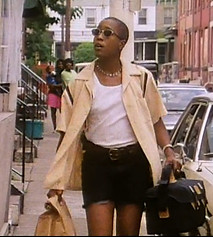
Cheryl Dunye in The Watermelon Woman
Nisha Ganatra in Chutney Popcorn
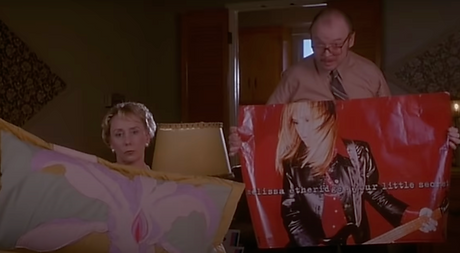
Megan's parents in But I'm a Cheerleader holding up incriminating evidence of her lesbianism
Thoughts on the 2000s
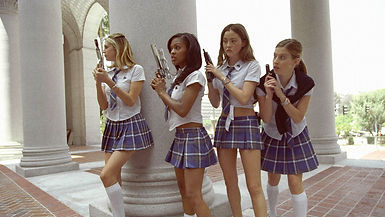
From 2000-2009, there are 39 films in this archive. This is double that of the previous decade, marking how lesbian films were moving from margin to center. This movement is facilitated by the number of nonlesbians in this era making films with lesbian characters, in contrast to the 90s, where queer women and lesbian filmakers where behind the scenes of most lesbian films. As a result, a lot of these films shift in topic and tone from the 90s, in which the focus was on love stories. In contrast, the 2000s lesbian movies listed here tend towards prestige dramas, many of which were Oscar nominated or Oscar winners. These mainstream success films are mainly directed by nonlesbians, including Mulholland Drive, The Hours, and Monster. The films directed by lesbians are also less intertextual than the 90s; less defensive in the wake of paths carved by their predecessors. While this means there is often less explicit queer theory padded into the texts, the space to breathe allows for bigger budget films that are still immensely personal and intimate, such as Waterlillies, and worthwhile genre films such as the enchanting romcom Saving Face, and the unapologetically silly spy film D.E.B.S. These films walk a balancing act of niche cinema and more mainstream acceptance of lesbians in general.
The series of films in the 2000s feels like the most in-between of these decades, as there is a mix of commercially successful and popular films alongside smaller indie films, which share characteristics with the films from the 90s. The films of the 2000s build off of the goals of earlier lesbian films to continue expanding the genre, and push the boundaries of what a lesbian film can look like.
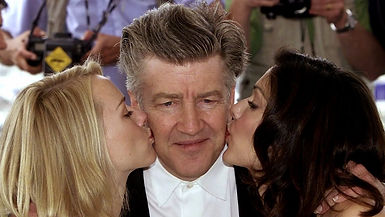
David Lynch with Naomi Watts and Laura Elena of Mulholland Drive
Sara Foster, Meagan Good, Devon Aoki, and Jill Ritchie as spies in D.E.B.S
Thoughts on the 2010s
A decade that is crucial for lesbians on tumblr, the 2010s is by the far the most prolific decade, with currently 134 movies in the archive. This is a huge increase in quantity, alongside a similar expansion in diversity. These films, more than any other decade, are truly from all over the world, and represent a wider swath of lesbians than before. This decade also is home to some of the movies that have become recognized as “quintessential lesbian films,” especially in online spaces, such as Carol, The Handmaiden, and Portrait of a Lady on Fire. Alongside these three films, and Blue is the Warmest Color (2013), the 2010s contains some of the most widely discussed lesbian films, for better and for worse. This decade is also the only of these decades where films directed by men outrank those directed by queer women and lesbian filmmakers. This could be attributed to the increase in number of films, as statistically there are many more male directors than women, in general, and lesbians in particular. However, it is still interesting that this is the first decade where that gap becomes apparent. The decade is also meaningful in that the rise of period pieces (which will continue in the 2020s) appears. While there have been period pieces throughout, this trend is especially apparent in the 2010s, because of the frequency of these films, as well as the mainstream acknowledgement of this trend. Once SNL has done a sketch on it, it means it’s in the air.
As a lesbian growing up during this period, I was able to see some of these films in theaters (with my mom) such as Battle of the Sexes, The Favourite, and Booksmart. There were also many of the more gratuitous films that I watched on my own (Blue is the Warmest Color and Duck Butter come to mind). The strength of this decade comes from the quantity more than the quality, but it does showcase the growing space for lesbian films in the mainstream, which cannot be undersold. While lesbian films in the mainstream have the ability to reach further audiences and build acceptance, they can lack the intimacy and the personal that was so important to the beginning of new queer cinema.
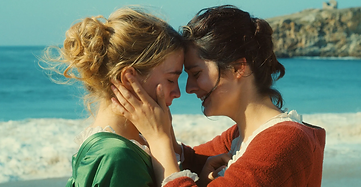
Adèle Haenel and Noémie Merlant in Portrait of a Lady on Fire
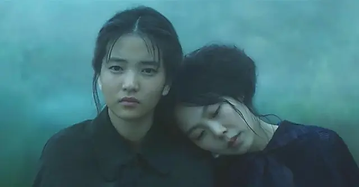
Kim Tae-ri and Kim Min-hee in The Handmaiden
Thoughts on the 2020s
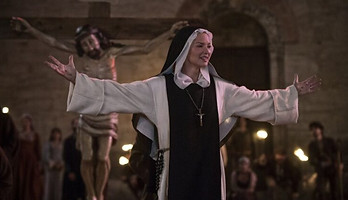
The 2020s (so far) are home to some of my favorite characters; mainly girls who are anxious and/or insane, making them a delight to watch (Old Dolio + Benedetta ily). Obviously, the 2020s are far from over, so this number will only continue to grow, but currently this archive houses 35 films made between 2020-2022. It is already heartening to see this many, which means the 2020s will likely outpace the 2010s, and continue the pattern of growth each decade. Thematically, these films are extremely diverse, from a horror trilogy focusing on lesbian love (The Fear Street trilogy) to a Bollywood film that highlights community between queer people (Badhaai Do). Further, while nonlesbians still outrank queer women and lesbian filmmakers, once again there are more queer women and lesbian filmmakers than male ones. The films of the 2020s thus far are a mix between the ongoing popularity of dramas,, but also more films that are aiming to be family friendly and mass marketable. This is especially relevant to the influx of lesbian Christmas movies (Happiest Season, Christmas at the Ranch, A New York Christmas Wedding) which work in this paradigm.
This decade is marked by films I absolutely love (Shiva Baby, Kajillionare, Benedetta) and also films I really don’t (Happiest Season). As the decade continues, I hope to see a wide variety of films, some that cater to the mainstream audience but still others that speak to lesbians directly, or include casual queerness that cannot be edited out to appease certain markets (the “first gay characters in Star Wars” which was a two second lesbian kiss followed by an equally long shot of a slug). This trend illustrates how representation is not the same as radical change, and that mainstream movies with one or two moments of queerness do not deserve praise for queer representation. The films from the 90s demonstrate how lesbianism and lesbian representation can be a site for radical politics. Mainstream representation too often leaves this radicality behind. Incorporation into the mainstream means more safety in expressions of lesbianism, which hopefully will lead to a reinvigoration of films made by and for lesbians.